
Looking to play at online casinos with more purpose?
Betting systems help you bet with structure—so you’re not just winging it. They won’t flip the odds in your favour, but they can help you stay in control, play within your limits, and maybe even make your bankroll last longer by incorporating a solid betting strategy.
Whether you want to ride out a lucky streak or keep things steady on a losing run, there’s a strategy that fits your style.
Betting Systems at a Glance
| Feature | Details |
|---|---|
| Good for | Players who want more control over their betting |
| Won’t do | Change the house edge or guarantee wins |
| Best used in | Roulette, blackjack, baccarat |
| Top pick for beginners | Flat betting or Paroli |
What Are Betting Systems?
Betting systems are simple tools that guide how much you bet, when to raise your stakes, and when to reset. You’ll see them used most often in games like roulette, blackjack, and baccarat—where small bet changes can shape how your session plays out.
A gambling system provides a structured approach to managing bets, helping players maintain control over their bankroll.
Why Use a Betting System?
Let’s be clear: no strategy beats the house edge. That’s not the point. Strategies help you play with purpose.
They give your bets structure, making it easier to:
- Avoid chasing losses
- Stay consistent instead of betting randomly
- Make the most of hot streaks
- Reduce the pressure of in-the-moment decisions
- Manage bankroll effectively to cover losses and maximise profitability
They offer control—even in games of chance. If you’re looking for a smarter, more disciplined way to play, a good system can help.
What Kind of Player Are You?
Not all strategies suit every style. Match your mindset to a system that fits:
| Player Type / Quote | Suggested System |
|---|---|
| “I like fast-paced action and don’t mind some risk.” | Try Martingale – high risk, high reward, but you need a firm stop-loss. |
| “I want more control and structure.” | Go with Paroli – a positive progression strategy that’s easy to follow. |
| “I enjoy patterns and numbers.” | Look at Fibonacci or Labouchère – both follow mathematical sequences. |
| “I just want to keep things steady.” | Try Flat Betting – consistent bets, great for budgeting. |
Types of Betting Systems
When it comes to betting systems, they generally fall into two main categories: progressive and fixed. Understanding these categories can help you choose a strategy that aligns with your risk tolerance and betting style.
Progressive Betting Systems
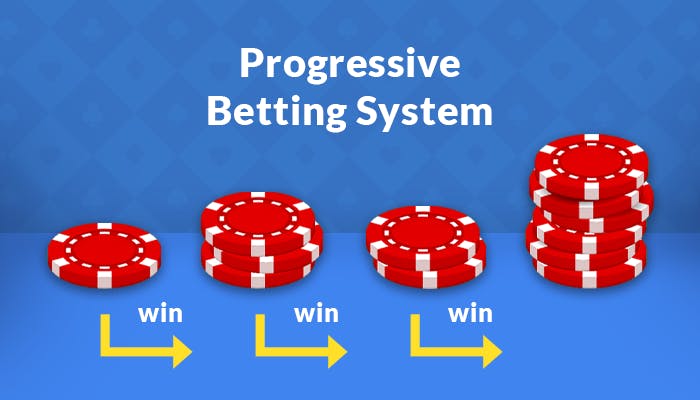
Progressive betting systems are dynamic. They adjust your bet size based on the outcome of previous bets. The idea is to either capitalise on winning streaks or recover losses more effectively. These systems can be divided into positive and negative progressions.
➕ Positive Progression
You increase your bet after a win. The Paroli system is a classic example, where you double your bet after each win to maximise profits during a hot streak.
- Paroli – Double after a win (usually 3-step sequence).
- 1-3-2-6 – A specific series designed to maximise short winning streaks.
- Oscar’s Grind – Small increases after wins to steadily reach a profit target.
➖ Negative Progression
You increase your bet after a loss. The Martingale system is the most well-known, where you double your bet after each loss, aiming to recover all previous losses with a single win.
While progressive systems can be exciting and potentially lucrative, they also come with higher risk. A losing streak can quickly escalate your bets, potentially leading to significant losses if not managed carefully.
- Martingale – Double after each loss.
- Fibonacci – Follow the Fibonacci sequence on losses.
- d’Alembert – Add one unit after a loss, subtract one after a win.
- Labouchere – Cross off numbers from a betting line, escalating stakes over time.
Fixed Betting Systems
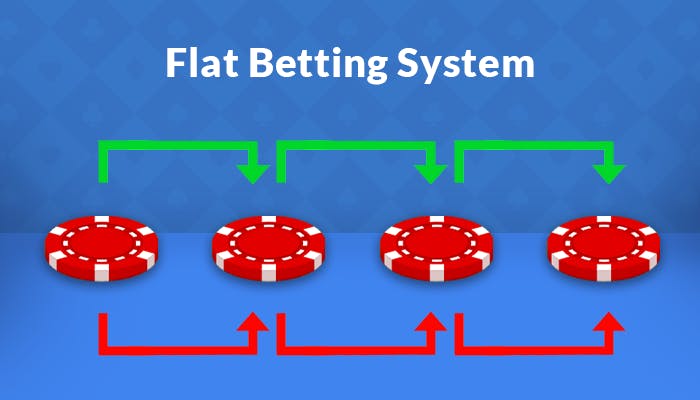
Fixed betting systems, on the other hand, keep your bet size consistent regardless of previous outcomes. This approach is all about stability and control, making it ideal for players who prefer a more conservative strategy. Fixed systems are generally safer and easier to manage, making them suitable for longer sessions and players who prefer a steady, disciplined approach.
Compare Popular Betting Systems
| Strategy | Risk Level | Complexity | Best Game Types | Ideal For | Maximum Bet | 💡 Pro Tip |
|---|---|---|---|---|---|---|
| Martingale | High | Easy | Roulette, Blackjack, Baccarat | Risk-takers, short-term | $200 | Set a stop-loss to avoid chasing big losses |
| Paroli | Medium | Easy | Roulette, Baccarat, Blackjack | Beginners, cautious play | $100 | Stop after 3 wins to lock in profits |
| Fibonacci | Medium | Moderate | Roulette, Baccarat, Blackjack | Strategic thinkers | $150 | Stick to even-money bets for best results |
| Labouchère | High | Hard | Roulette, Blackjack, Baccarat | Pattern-focused players | $250 | Write out a clear sequence before starting |
| Flat Betting | Low | Easy | Any | Budget-conscious players | $50 | Great for long sessions with low variance |
| D’Alembert | Medium | Easy | Roulette, Blackjack, Baccarat | Balanced players | $150 | Safer than Martingale, but losses can add up |
| Oscar’s Grind | Low | Moderate | Blackjack, Baccarat, Roulette | Patient bankroll builders | $100 | Only increase bets after wins |
| 1-3-2-6 | Medium | Moderate | Blackjack, Baccarat, Roulette | Short-run optimists | $100 | Stick to the sequence—reset after any loss |
Each strategy above links through to its own in-depth guide with worked examples. As a quick orientation: Roulette and Baccarat suit even-money progressions like Martingale, Paroli, Fibonacci and D’Alembert; Blackjack works with the same systems but pairs best with Flat Betting or Oscar’s Grind for slower, lower-variance sessions. Thrill-seekers gravitate to Martingale and 1-3-2-6; budget-conscious players are better served by Flat Betting.
We Ran the Numbers: Martingale vs Flat Betting
To show what these systems actually do to a bankroll, we simulated 100 spins of European roulette (single-zero, 2.7% house edge) on even-money bets. Both runs used a $200 starting bankroll. Martingale started at a $5 base bet and doubled after each loss; Flat Betting placed a steady $5 on every spin. Each system was capped by the bankroll itself as the stop-loss.
| Metric | Martingale ($5 base) | Flat Betting ($5 flat) |
|---|---|---|
| Starting bankroll | $200 | $200 |
| Peak bankroll | $255 | $215 |
| Lowest point | $5 | $170 |
| Longest losing streak | 6 spins | 6 spins |
| Worst single bet reached | $160 | $5 |
| Bankroll after 100 spins | $40 | $185 |
| Biggest risk | One cold streak nearly wiped the account | Slow, predictable bleed |
The contrast is the whole story. Martingale spent most of the session looking healthy—it climbed to a $255 peak and recovered small losses quickly—right up until a 6-spin losing run forced the bet from $5 to $160 and dragged the bankroll down to a single $5 unit. Flat Betting never had a dramatic moment in either direction: it drifted between $170 and $215 the entire time and finished close to even.
The takeaway: progressive systems like Martingale don’t reduce your risk, they concentrate it. You win small amounts often and lose big rarely—but the rare loss is the one that matters. Flat Betting trades excitement for survivability. Neither beats the 2.7% edge over time; they just distribute the same expected loss very differently.
Do Betting Systems Actually Work?
They don’t change the odds—the house edge stays the same. For example, European roulette always has a 2.7% edge.
But systems can affect how a session feels:
- Help recover losses methodically
- Lock in wins during streaks
- Stretch your bankroll longer
- Reduce emotional betting
As our simulation above shows, the value of a system is in how it shapes a session—not in changing the maths. Use them with realistic expectations and firm limits.
Frequently Asked Questions
Is the Martingale system banned in casinos?
No—Martingale itself isn’t banned, because it doesn’t give players an edge. What casinos use to limit it are table maximums. Once your doubled bet hits the table cap (often after 6–8 consecutive losses on a low base bet), you can no longer double to recover, which is exactly why a cold streak is so dangerous. The table limit, not a rule against the system, is what breaks Martingale.
What’s the difference between Paroli and Martingale?
They’re mirror images. Martingale is a negative progression—you double after a loss to chase a recovery, risking large amounts to win small ones. Paroli is a positive progression—you double after a win to ride a hot streak with the house’s money, risking small amounts to win larger ones. Paroli is far safer for your bankroll because losses stay capped at your base bet.
Do betting systems work on pokies or slots?
Not really. Betting systems are built for even-money bets (red/black, odd/even) where outcomes are close to 50/50. Pokies have far higher volatility and no even-money proposition, so progressions like Martingale escalate dangerously fast and Flat Betting is the only sensible approach. Systems belong at the roulette, blackjack and baccarat tables, not the reels.
What bankroll do I need to run Martingale safely?
More than most people expect. With a $5 base bet, surviving a 7-loss streak requires being able to cover a $640 bet on the eighth spin—so a “safe” Martingale bankroll is often 100–150x your base unit. In our simulation a $200 bankroll at a $5 base nearly busted on a 6-spin run. If you want to try it, keep the base bet tiny relative to your total funds and set a hard stop-loss.
Which betting system is best for beginners?
Flat Betting or Paroli. Flat Betting is the simplest and lowest-risk—you bet the same amount every time, making it easy to budget and impossible to blow up on a bad run. Paroli adds a little upside by letting winning streaks build while keeping losses capped. Both avoid the steep escalation that makes Martingale and Labouchère risky for newcomers.
Conclusion
Want help choosing your first betting strategy? Check out our Paroli betting guide or Flat Betting guide to get started. Whichever you pick, remember the lesson from our simulation: a system can shape how you play, but only sensible limits protect your bankroll.